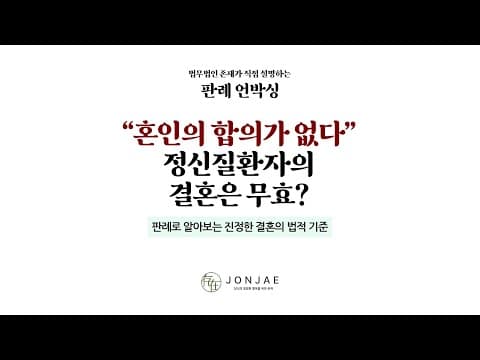
A marriage on a single sheet of paper that turned out to be void
Once you stamp the marriage registration, the legal marriage begins — many believe so. But courts examine very strictly whether an actual "agreement to marry" existed. The Busan Family Court 2018Deudan216724 decision introduced here clearly shows how that standard works.
The two people had met as patients at the same hospital. A three-month relationship, a marriage registration without telling the family, no wedding ceremony, no cohabitation — comprehensively weighing these circumstances, the court declared the marriage void. I see this case as the clearest demonstration that the essence of marriage is "agreement," not "registration."
Case overview — marriage registration three months after meeting in the hospital
Plaintiff A and defendant B met while being treated for schizophrenia and bipolar disorder respectively at the same hospital, and began a relationship. The core facts are:
- Relationship of about three months
- Marriage registration in May 2017
- Registration filed without informing the family
- No wedding ceremony, no cohabitation
- No substantive life as a married couple even after registration
The existence of the agreement to marry was later contested, and the case went to the family court.
Issue — was there an "agreement to marry" under Civil Act Article 815 No. 1
The core issue was whether the case fell under Civil Act Article 815 No. 1 — "where there is no agreement to marry between the parties." What the court means by an "agreement to marry" is not merely the act of stamping a document.
"An agreement to marry means a genuine meeting of intent to form the spiritual and physical union recognized as a marital couple."
In this case the two only registered; there was no wedding ceremony, and no cohabitation at all. Whether they possessed the substantive intent to form a spiritual and physical union was contested.
The court's decision — two key grounds
The court declared the marriage void. Two key grounds underpinned the decision.
(1) The inability to make normal judgments at the time of registration
Both parties were being treated for psychiatric conditions, and it was comprehensively recognized that at the time of registration they were in a state where free decision-making was difficult. The issue was not the presence of illness itself, but the capacity for intent at the moment of registration.
(2) The complete absence of any marital substance
Circumstances after registration were also decisive.
- No wedding ceremony
- No cohabitation
- No formation of economic or living community as a married couple
- No external appearance that society would recognize as a marital couple
The court held that "only the documentary registration existed, with no substance of joint marital life," and that the agreement to marry itself was therefore denied.
What this precedent teaches us
When I talk about this case with colleagues, I usually sum it up in a single sentence: "Marriage is agreement, not registration." Courts typically recognize marriage invalidity only very restrictively. Even so, this case offers a clear baseline.
- Marriage registration is a form; the essence is the genuine intent to engage in joint marital life
- Where free decision-making is difficult due to illness, the effect of the registration can be shaken
- Where there is no substance such as cohabitation, ceremony, or economic community after registration, marriage invalidity may be recognized
Patterns frequently seen in practice
Inquiries of a similar flavor typically come in the following forms.
- "An acquaintance filed only the registration and then disappeared. Can I file for invalidity?"
- "There are signs that a parent with progressing dementia filed a marriage registration."
- "It was a sham registration with a foreigner; there was no cohabitation."
The facts of each case differ, but the following materials commonly become central.
- Medical records evaluating capacity at the time of registration
- External materials showing absence of marital substance, such as no cohabitation or no ceremony
- Circumstantial evidence such as the fact that family was not informed
Marriage invalidity is a narrow field of recognition, but when materials are coherently assembled, the possibility of recognition clearly opens.
FAQ
Q. If only the registration was filed, is the legal marriage established even without cohabitation? A. Typically the legal marriage begins with registration, but the registration is not absolute. If circumstances make clear there was no agreement to marry, invalidity can be recognized.
Q. If there is a psychiatric condition, does the marriage automatically become void? A. No. The presence of the condition itself does not automatically render the marriage void; whether capacity for intent was lacking at the time of registration is evaluated through medical records and other objective materials.
Q. How is marriage annulment different from marriage invalidity? A. Annulment extinguishes the effect prospectively on the ground of a specific cause, while invalidity treats the marriage as never having been formed in the first place. This case was decided as void due to the absence of agreement.
If you or your family is in a similar situation, organize the medical records around the time of registration and the circumstances afterward first. We can help with the initial fact-organization through Chat with us now.
Closing
The teaching of this precedent is clear. The law gives greater weight to a substantive agreement to be a couple and to the actual fact of life together than to a formal registration. Even where a registration exists, if materials prove the absence of substantive agreement — the court will not protect that registration.
Family cases are a field in which accumulated material drives the outcome. Do not stop at the suspicion that "the registration seems wrong"; organize the circumstances by time and item. Chat with us now
Author: attorneys Roh Jongeon and Yoon Jisang Reviewed: 2026-05-30
This article organizes general family/inheritance legal information and is not legal advice on a specific matter. Conclusions vary by facts and evidence, so please obtain a consultation for any concrete matter.