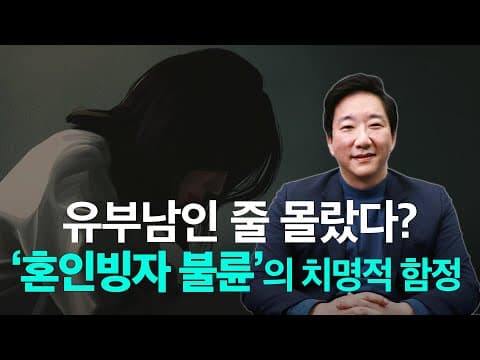
The single sentence I hear most often in consultations: "I am going to get divorced"
A significant share of the people who come to my office have heard the same sentence at roughly the same point in their relationship: "I am going to settle things with my wife soon. I want to marry you." When you first heard that line in person, it was difficult to picture what kind of lawsuit it would turn into months or years later. As a Korean family-law attorney handling these cases, I see this pattern repeat itself, and every time the ending takes the same shape I feel the need to write it down. This article is general legal information about why marriage-pretext affairs so often end in spousal-affair (sanggan) lawsuits, and what you should be organizing right now if you are inside such a relationship.
Many people assume affairs are kept perfectly hidden, but in actual case files the third party often ends up contacting or even confronting the spouse directly. Why does such a risky choice keep repeating? When you read through the case records, the third party at that point no longer perceives the relationship as one that has to stay hidden. From their point of view it is a marriage about to end, and they are the person who will take the next seat -- that scenario is already fixed in their head.
A relationship that truly matters usually has slightly clumsy edges. A relationship that arrives only in a polished, fairy-tale shape deserves at least the suspicion that something inside it has been manufactured.
The psychology of the side that does not want to break up the family, and the signs that there is no real intent to leave
When I reorganize the facts in consultation, the person who made the promise usually had no real intent to dissolve the marriage from the start. More precisely, they take the position of not wanting to lose either party, so they say contradictory things to both. To the spouse they signal continued commitment, and to the third party they keep repeating "soon I will sort it out."
When these signals appear even once or twice, ending the relationship is the choice that best protects you. The patterns below are common signals that there is no real intent to leave.
- They never show you a single concrete document -- no separation agreement, no consensual-divorce filing, no certificate of separation
- They attend family events, holidays, and their children's school occasions together with the spouse
- They keep renewing conditions -- "not while the kids are still...," "not while my parents are still...," "once work calms down..."
- They cannot cut off communication or daily contact with the spouse
- They cannot disclose the relationship to their own family or close friends
The counter-attack pattern that often follows once the lie is exposed
The ending I see most often goes like this. At some point the promise is exposed as a lie. The most common discovery route is the spouse becoming aware through phone, account, social media, or vehicle dashcam evidence. From that point, the person who received the promise -- driven by anger and a sense of betrayal -- frequently contacts or confronts the spouse directly.
The problem is that at this moment the legal weight shifts. Beyond being named defendant in a sanggan damages claim for the affair itself, if the direct contact with the spouse was aggressive, separate criminal exposure for intimidation, defamation, or stalking-prevention-act offenses is commonly reported.
How Korean courts approach a sanggan lawsuit
The Supreme Court has consistently held that infidelity is an unlawful act that damages the essence of the marital community. A simple claim that you "thought he would marry you" or "thought he was already divorced" is not by itself enough to neutralize the unlawfulness. Courts usually weigh the following factors as a whole.
- Whether the third party knew, or could have known, that the other side was married (awareness and constructive awareness)
- The duration, frequency, and outward shape of the relationship (cohabitation, travel, money transfers, level of social-media disclosure)
- The degree of mental suffering inflicted on the spouse, and the presence of children
- The conduct after the relationship was exposed (remorse, apology, promise not to repeat versus mockery or further contact attempts)
Even if you continued the relationship believing only the line "I am going to get divorced," if there were objective circumstances showing the other party was married (a wedding ring, family photos, the home address, the presence of children), it is hard for the court to deny your liability -- that is the common direction.
What public cases keep showing us
In some publicized cases as well, the person who believed they had been promised marriage still ended up sharing one axis of the damages liability. A promise made by a socially powerful person is not, for that reason, legally stronger. The more dazzling the appearance of the promise, the heavier the eventual shock when the promise is broken and the person returns to their original family.
The more dazzling the promise, the harder the recovery once it breaks. The moment you are receiving a dazzling promise is exactly the moment to step back and examine the objective evidence.
What I would like to leave with anyone still inside such a relationship
The purpose of this article is not moral condemnation but a practical guide from an attorney who hears the same consultations repeatedly. Whichever seat you currently occupy, the following three points are worth organizing.
- Organize the objective circumstances of the other side's marital status (resident-registration family relations, living arrangement, presence of children) along your own timeline
- Check whether you have ever directly seen any document that confirms the substance -- not the appearance -- of the promise (a separation agreement, a consensual-divorce filing, real separation from the family)
- Decide in advance, while you are calm rather than emotionally charged, the tone in which you will respond once the relationship becomes known (direct confrontation or contact significantly increases the risk of additional liability)
Why I do not want you going directly to the spouse
The two actions clients in my office regret most are these. One is contacting or visiting the spouse directly while in a state of rage. The other is the heated expressions that end up preserved in recordings, text messages, or social media during that process. Regardless of your own perception that you are a victim, those actions are submitted as evidence against you in subsequent damages litigation and criminal proceedings.
Even when the anger is justified, the safer way to express it is through a refined channel with counsel's assistance. From Chat with an attorney now you can check which items to organize first in your situation.
Frequently asked questions
Q. If I can prove I sincerely believed the promise that he would marry me, can the damages be reduced? A. The common direction is that a purely subjective belief alone rarely leads to a full exemption from liability. Still, if there are objective circumstances showing you could not have known the other side was married (for example, a separation agreement was shown to you, or a fabricated family-relations certificate was even presented), the degree of liability sometimes shrinks. The outcome depends heavily on the facts and the evidence.
Q. The spouse contacted me first demanding I admit the relationship, and I left an apology message. Will it work against me? A. An apology itself can be a human gesture, but the wording, timing, and context of that apology can be read as an admission of the affair itself. Even if you want to apologize, it is safer to organize the wording and the channel with counsel's assistance.
Q. The relationship is over now. The spouse has somehow found out and is contacting me. Is there still a way to close this cleanly? A. Usually we close it along one of two paths. First, confirm what the spouse intends to claim and how strong their evidence is, then close it through negotiation. Second, if litigation proceeds, organize your awareness and the surrounding circumstances and contest the amount of damages. In either path, contacting the spouse directly yourself is not recommended.
Whichever seat you currently occupy, simply organizing the accurate circumstances changes the outcome. From Chat with an attorney now we can help you organize a plan that fits your matter.
This article is general legal information written based on the YouTube commentary above by attorneys of Jonjae Law Firm.
Last reviewed: 2026-05-30
Disclaimer: This article is provided as general legal information and is not legal advice on the specific facts of any individual case. Outcomes may vary depending on the facts and evidence, so anyone facing an actual dispute or needing consultation should obtain individual advice from a qualified attorney.