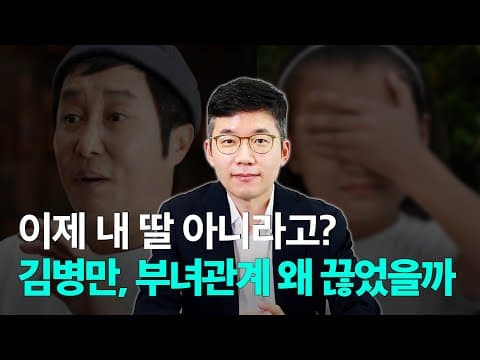
The full adoption dissolution ruling involving comedian Kim Byung Man was reported in the media, renewing public interest in adoption and its termination. Inquiries about adoption procedures and the possibility of dissolution have also increased in the consulting room as a result of this case. This article uses the case as a starting point to summarize how parent-child relationships are legally created and dissolved, how general adoption differs from full adoption, and what should be considered first when contemplating adopting a child in a remarried family.
What Was Recognized in the Kim Byung Man Case
The main points of the case as reported in the media are as follows.
- Kim Byung Man married his former spouse and adopted her child as a full adopted child.
- He later divorced the former spouse and separately filed a petition for dissolution of the full adoption.
- The court issued a dissolution ruling, terminating the legal parent-child relationship between Kim Byung Man and the child.
Two points are worth highlighting. First, unlike dissolution of general adoption, dissolution of full adoption cannot be ended by agreement and is only possible through a judgment. Second, since the effect of full adoption is powerful, the dissolution is also a heavy procedure for reversing that effect.
Two Branches of the Legal Concept of Family
The parent-child relationship in family law is divided into two branches.
- Parent-child relationship by blood: The relationship between mother and child is automatically established by the fact of birth, and the relationship between father and child is established by legal presumptions such as marriage.
- Legal parent-child relationship by adoption: Created between parties without a blood relationship through intent and procedure.
In both cases, the legal effects such as inheritance, parental rights, and support are identical. Because adoption, once established, has the same effect as a blood relationship, the law sets strict requirements for its beginning and end.
Two Paths to Blood Parent-Child Relationships
First, we need to organize how blood parent-child relationships are recognized.
Presumption of conception during marriage
- A child born 200 days after the marriage registration date
- A child born within 300 days from the termination of the marriage
Children in these two cases are presumed to have been conceived during the marriage and are legally presumed to be the husband's children. If this presumption differs from the facts, it can be challenged through a separate denial of paternity lawsuit.
Recognition of children born out of wedlock
For children born without a marriage relationship, the relationship with the biological mother is naturally established by birth. However, the relationship with the biological father is recognized only after a separate recognition procedure. Once recognition is made, its effect retroacts to the time of birth, generating legal effects such as parental rights, support, and inheritance.
A representative example is the child born between actor Jung Woo-sung and model Moon Ga-bi. Since there is no marriage relationship between the two, the biological mother automatically establishes the parent-child relationship through birth, while the biological father must go through a separate recognition procedure to create the parent-child relationship.
How General Adoption and Full Adoption Differ
Adoption is divided into general adoption and full adoption. The differences between the two systems can be summarized in the table below.
| Item | General Adoption | Full Adoption |
|---|---|---|
| Establishment | Agreement + registration | Family court judgment |
| Relationship with biological parents | Maintained | Terminated |
| Relationship with adoptive parents | Newly established | Newly established (deemed biological child) |
| Child's surname | Maintained | Changed to adoptive father's surname |
| Dissolution | By agreement or judgment | Only by judgment |
| Adoptive parent requirements | Relatively lenient | Strict (married couples, 3+ years of marriage) |
Features of general adoption
General adoption is established by agreement between the parties and the registration of adoption. Once effective, the child is subject to the parental rights of the adoptive parents, and a family relationship is formed with the adoptive parents' relatives. However, the key point is that the parent-child relationship with the biological parents also continues. That is, the parent-child relationship is established with both adoptive and biological parents, allowing inheritance from both sides.
Features of full adoption
Full adoption is only possible through a family court judgment. The adoptive parents must typically be a couple married for 3+ years and must meet strict requirements including the consent of the biological parents. Once effective, the parent-child relationship with biological parents is terminated, and the child is deemed a biological child of the adoptive parents. The child's surname and family origin are also changed to those of the adoptive father.
One reason adoption has often been pursued in remarried families is the issue of the child's surname. After divorce and remarriage, the biological father and child share the same surname, while the remarried adoptive father and child have different surnames; full adoption has been used to change the child's surname to that of the remarried adoptive father.
Why Full Adoption Dissolution Is Only Possible Through Judgment
Full adoption dissolution cannot be ended by agreement and must be done through a family court judgment. The reason is that the effect of full adoption is very powerful.
Once full adoption is established, the parent-child relationship with biological parents is terminated, making it difficult to restore that relationship through dissolution. Dissolution is only recognized when strict requirements are met, such as abuse of the full adopted child by the adoptive family or other grounds that significantly harm the child's welfare.
In Kim Byung Man's case, the specific reasons for the ruling are difficult to fully verify within the publicly available scope, but the fact that the court granted dissolution itself means that there were circumstances meeting the dissolution requirements in that case. The acceptance of full adoption dissolution should be read as a signal that there were correspondingly heavy facts.
Full adoption dissolution is not accepted simply because the adoptive parents and child have grown distant. Strict requirements such as grounds significantly harming the child's welfare are required.
What to Consider When Contemplating Adoption in a Remarried Family
The most frequent advice I give when consulting on adoption in remarried families is that going straight to full adoption to solve the child's surname issue is not always the answer. If circumstances change after adoption and dissolution must be considered, full adoption dissolution is very difficult.
I recommend considering the following points in advance.
- Whether the child's surname issue can be solved by other means: There are cases where methods other than full adoption are possible, such as changing the parent with parental rights or requesting a change of surname and family origin.
- Whether you really want to sever the relationship with biological parents: Once full adoption is established, the parent-child relationship with biological parents is terminated. If the child wishes to maintain a certain relationship with the biological father or mother, general adoption or other methods may be more appropriate.
- Prior review of divorce and re-divorce possibilities: Statistically, the stability of remarriage being lower than first marriage cannot be ignored. Since full adoption has a powerful effect, the procedure to reverse that effect is also heavy, and this should be fully recognized in decision-making.
- The child's intent and welfare: Consider what full adoption means to the child and how the child can participate in that decision.
In consultations on adoption in remarried families, I tend to recommend that all family members take sufficient time to discuss before deciding. Adoption is heavy at the start, and reversing its effect is also heavy.
Frequently Asked Questions
Q. Which should I choose, general adoption or full adoption? A. There is no set answer. The appropriate choice varies depending on whether changing the child's surname is necessary, whether you want to terminate the relationship with biological parents, and how you want to structure the inheritance of the adoptive family. Family discussion along with separate legal review is necessary.
Q. If I divorce after a full adoption, does the adoption automatically become void? A. No. Full adoption is a procedure that creates a parent-child relationship between the adoptive parents and the child, so the divorce of the adoptive parents does not automatically terminate the parent-child relationship. If you wish to dissolve, a separate full adoption dissolution petition must be filed with the family court.
Q. What are typical grounds for granting full adoption dissolution? A. Typical grounds include abuse of the full adopted child by the adoptive parents, significant neglect of the full adopted child's upbringing, abuse of the adoptive parents by the full adopted child, and other grave reasons making it difficult to maintain the full adoption relationship. The child's welfare is the most important standard.
Closing
Kim Byung Man's full adoption dissolution ruling is a case that once again demonstrates the powerful system of full adoption and the gravity of its dissolution procedure. Adoption creates the same legal relationship as a biological child between two unrelated parties, and full adoption is the strongest form among them, terminating even the relationship with biological parents. If considering adoption in a remarried family, I recommend deciding by considering both the long-term effects of adoption and the gravity of the dissolution procedure, rather than focusing only on the short-term goal of solving the child's surname issue.
Written by: Attorney Yoon Jisang, Jonjae Law Firm. Last reviewed 2026-05-30
This article is for general legal information purposes and does not guarantee the outcome of individual cases. The conclusion of adoption and dissolution may vary depending on the circumstances of family members and the child's welfare, so please consult an attorney separately for specific cases.