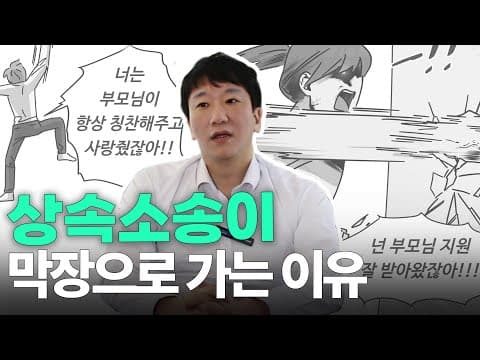
The question, "Why do they fight this fiercely?"
Inheritance division, on the outside, is arithmetic. There is a statutory share; you add or subtract special benefit and partly reflect contribution shares; a result emerges. But the clients I meet are far from calm. Siblings split as if they were enemies and morally demonize each other. While handling inheritance cases, I have often asked myself, "Why do people fight so fiercely in inheritance suits?" I organize the answer here.
The surface cause: the decedent's death and distribution
The most direct cause is, of course, the decedent's death and the ensuing distribution. Even among siblings of the same parents, when shares differ, conflict tends to start. But this is only the surface; it does not explain everything that drives such intensity. Even in cases with modest amounts, the intensity is usually no different.
The deeper cause: accumulated discrimination and deprivation from upbringing
The essence of inheritance litigation is that, through the event of the decedent's death, decades of family discrimination, deprivation, and the need for recognition burst out at once.
Inheritance cases are, in the end, a settlement of decades of family history. They are not simple money issues; they carry an emotional layer. The aspect of a case shifts greatly depending on accumulated family circumstances, even at the same amount.
A typical case structure
In consultations, the following structure repeats.
- One child is established early and received relatively less help from the parents
- Another child has not yet established, receiving more support for school, business funds, living costs
- Established child: pride that "I made it here without much parental help"
- Less-established child: deprivation that "Parents always praised the other; I was the comparison object"
When these two emotions meet, simple distribution disputes turn into moral verdicts. A ratio dispute morphs into a contest of "who is the worse child."
The established child's view
- "I lived diligently from early on and used less of my parents' resources"
- "My sibling failed in business, and parental wealth flowed each time that happened"
- "The remaining inheritance should be at least fair to me, or I should receive more"
The less-established child's view
- "I was compared to my sibling all my life"
- "Parents always praised them; I was never recognized"
- "Taking less of the inheritance now is to take away my parents' love until the end"
These differences in view are hard to objectively judge as right or wrong, but they significantly affect how the case flows.
Why the suit becomes "ugly"
An inheritance division suit is essentially the following organizing work.
- Confirming the property left by the decedent
- Adding lifetime gifts (special benefit)
- Reflecting contribution shares partially
- Calculating each share from the above
The hardest step is proving "who received how much during the decedent's lifetime." Cash gifts often lack evidence; items like education, marriage funds, and business funds are only partially documented. Family members all know, but the court does not.
- Recipients try to hide receipts
- Non-recipients try to prove receipts
In this process, old emotions within the family are dragged out, leading to mutual moral demonization. For the attorney, it becomes a case where evidence collection and emotional management must proceed together.
Parents' role: what can be done while alive
- Listen sufficiently to children and recognize each one's sense of deprivation
- Substantive equality rather than formal equality in distribution
- Clearly record who received what (notarized wills/trusts are usually recommended)
- Reduce comparative comments between children; distribute expressions of recognition evenly
These efforts may not prevent all disputes, but they usually lower their intensity. In Korean society, parents' attempts at "fair distribution" themselves send strong messages to the children.
Advice to clients as an attorney
- Separate emotion and right
- Share with your attorney every flow of money and evidence truthfully
- A suit aimed at moral condemnation of siblings usually does not satisfy the outcome
- Consider mediation and settlement possibilities at every stage available
Ways to reduce dispute intensity
- If the decedent's lifetime intent is clear, externalize via a notarized will
- Some assets can be separated via trust (e.g., family trust) to reduce dispute potential
- For real property, organize while alive (sale, gift) to remove it from the division target
- Share distribution plans with children in advance to align expectations
- Leave explicit explanations of fairness on the record at family meetings
These preparatory measures usually greatly reduce the possibility of disputes.
What clients should remember once a case starts
- A lawsuit is a tool for organizing rights, not a tool for emotional recovery
- Do not be absorbed in short-term victories; also consider long-term recovery of the family relationship
- Family members who are not active in proceedings are also affected by the outcome
- Keep the possibility of mediation and settlement open until the end through family meetings
- Trust the attorney and share all facts so strategy can work
These principles help protect the family relationship after the case concludes, regardless of the outcome.
Frequently asked questions
Q. Cash received during lifetime lacks evidence; can we still dispute it? A. Bank transfer records, card usage flows, family messages, and real-estate transaction money flows are often combined for dispute. Some areas remain hard to prove, so working with an attorney on evidence strategy from the start is good.
Q. Is there a way to restore sibling relationships? A. Hard via litigation itself, but active use of mediation early can sometimes loosen some emotional knots beyond a formal outcome.
Q. What is the most effective prevention while parents are alive? A. A notarized will is usually the strongest tool. Also, sharing in advance who will receive what and why in a family meeting usually greatly reduces post-mortem disputes.
Get a consultation by chat now
Closing
Inheritance disputes are essentially a settlement of family history, leaving wounds far deeper than they appear from outside. If signs of dispute are visible, organizing materials while the decedent is alive and, if possible, sharing the organized records with everyone in the family is usually the strongest preventive measure.
Get a consultation by chat now
Drafted by Attorney Noh Jongeon. Reviewed 2026-05-30.
Disclaimer: This article organizes general aspects of inheritance disputes and is not legal advice for a specific case. Conclusions may differ by facts; please consult an attorney directly for specific matters.